 Maxim Skorohod, SkoreHood
What calls does a real estate team actually get?
A real estate phone line carries at least five different kinds of calls, and a generic answering script treats them all as "take a message." That is the core problem. A buyer standing outside a listing wants a showing time. A homeowner asking what their house might sell for wants a listing agent. A renter wants to know if the unit is still available. Each one is worth something different and belongs to a different person on the team.
| Call type | What the caller wants | What to capture | Where it should go |
|---|---|---|---|
| Showing request (sign call, portal tap-to-call) | See a specific listing, often today or this weekend | Listing address, preferred times, pre-approval status, whether they have an agent | Booked showing slot with the listing or buyer agent on duty |
| Buyer search inquiry | Help finding a home in an area or price range | Area, budget, timeline, financing, must-haves | Buyer agent rotation for a consult |
| Seller / valuation call | "What is my home worth?" or "I'm thinking about selling" | Property address, timeline, reason for moving, whether they also need to buy | Listing agent, booked listing appointment |
| Rental inquiry | Availability, rent, move-in date, pets | Unit, move-in date, household details the leasing team asks for | Leasing agent or property manager, not the buyer rotation |
| Existing client | Update on an offer, inspection, or closing | Name, property, what they need | Their own agent, flagged as priority |
Here is what we have found setting these up: the biggest leak is not that calls go unanswered, it is that answered calls get flattened into the same message. A seller lead written down as "someone called about a house" and dropped into a shared inbox goes cold just as surely as voicemail. Sorting the call by type on the first ring is what turns an answering service into a lead system.
And unanswered calls are still a big leak. For service businesses, 27% of inbound calls go unanswered, and fewer than 3% of callers pushed to voicemail leave a message, according to Invoca (2024). In real estate the caller has a list of other agents one tap away on the same portal page.
Citation capsule: NAR's 2024 Profile of Home Buyers and Sellers found that 88% of buyers and 90% of sellers used an agent, and most contacted only one. Because buyers and sellers rarely interview a second agent, the team that answers and correctly routes the first call usually wins the business.
Want the full breakdown of what each missed ring is worth? Read how missed calls cost service businesses revenue.
How does the agent handle buyer, seller, and rental calls differently?
SkoreHood's AI voice agent answers in about 0.4 seconds, asks one sorting question up front, then runs a different script for each kind of caller. The point is that a buyer, a seller, and a renter should each leave the call with the right next step, not the same "someone will call you back." Most setups go live in 48 hours.
Buyer calling about a listing
- Identify the property. Address, MLS number, or the sign the caller is looking at.
- Answer the basics from the listing sheet. Price, beds and baths, parking, HOA, open-house times: whatever your team loads into the script.
- Qualify lightly. Pre-approval or financing status, timeline, and whether they already work with an agent.
- Book the showing. Offer open slots from the showing agent's calendar and confirm on the call.
Homeowner thinking about selling
- Capture the property and timeline. Address, when they want to move, and whether they also need to buy.
- Do not guess a price. The agent never quotes a value on the phone; it books the listing appointment where a human prepares one.
- Route to a listing agent. Seller leads skip the buyer rotation and go to whoever takes listing appointments.
Renter or tenant inquiry
- Confirm the unit and availability. If it is leased, capture what they want and offer to pass on similar units.
- Collect the leasing team's questions. Move-in date, household size, pets, and anything else your leasing team asks first.
- Hand off to leasing. The lead goes to the leasing agent or property manager, so rental calls do not crowd the sales pipeline.
Every call ends the same way on the back end: a clean summary with the caller type, the property, the answers, and the booked time lands in the team's inbox or CRM within seconds. The dreaded "I think someone called about the Maple Street listing" mystery disappears, and nobody on the sales side wastes a morning calling back a rental inquiry.
Citation capsule: In BIA/Kelsey's "Phone Calls Are the New Click" report (2014), 66% of small businesses rated inbound phone calls a good or excellent lead source, the top-rated channel ahead of online forms (58.2%) and email (43.7%). For a real estate team, a call sorted correctly into buyer, seller, or rental is worth more than any form fill.
See how our missed-call recovery voice agent is configured for real estate inbound calls.
Speed-to-lead: answering sign calls and listing inquiries in seconds
In real estate, speed-to-lead is the single biggest predictor of who books the showing, because a listing inquiry is shared across agents the moment it is posted. The Harvard Business Review analysis (2011) found firms that respond within five minutes are about 100 times more likely to actually connect with a web lead than firms that wait 30 minutes. On a sign call, "in seconds" beats "next business day" every time.
What is speed-to-lead? Speed-to-lead is the elapsed time between a prospect reaching out and your team responding. In real estate it covers three channels that behave differently: sign calls from someone parked outside the house, tap-to-call and message inquiries from listing portals such as Zillow, Realtor.com, or Homes.com, and form fills from your own site.
Portal inquiries are where the clock runs fastest. The buyer is looking at the same listing page as everyone else, scrolling through other homes, and often contacting more than one of them in the same sitting. The first agent who confirms a showing time usually becomes "their" agent for the search. A callback two hours later reaches someone who has already booked a tour elsewhere.
Most teams measure speed-to-lead on web forms and quietly ignore the phone. We'd argue the phone is where the bleeding is worst. A form auto-responder fires in seconds. The buyer standing on the curb who calls the sign at 7 p.m. hits voicemail, and that is the higher-intent lead by a wide margin. Fix the phone first, then polish the rest.
Citation capsule: Speed wins deals. Harvard Business Review's 2011 study of roughly 100,000 leads showed a five-minute response makes firms about 100 times likelier to connect than a 30-minute wait. An AI agent that answers sign calls and portal inquiries in seconds captures the buyer interest a callback-tomorrow approach loses.
For more on turning fast answers into recovered revenue, see how speed-to-lead drives missed-call recovery.
Open-house weekends and new-listing spikes: who answers when everyone is showing?
Real estate call volume does not arrive evenly. It bunches up when a listing goes live, when the price drops, and across open-house weekends, which are exactly the hours when every agent on the team is inside a property with buyers. A single front-desk person or a live answering desk staffed for an average day hits a queue; an AI agent answers every simultaneous call on the first ring.
Think about a Saturday with two open houses. Agents are greeting visitors, one new listing hit the portals on Thursday, and the phone is getting the same five questions about it over and over: Is it still available? What's the HOA? Can I see it Sunday? Is there parking? Has it had offers? Here is how the agent handles that weekend:
- Answers listing questions from the sheet. Price, beds, baths, HOA, parking, school district name, open-house hours: whatever the team loads in. Anything not on the sheet gets noted for the agent rather than guessed.
- Turns "can I see it?" into a booked private showing. Callers who can't make the open house get a slot from the agent's calendar instead of a promise to call back Monday.
- Points drop-ins to the open house. Gives the address and hours, and captures name and number so the agent can follow up afterwards.
- Flags offer and status questions for a human. "Has it had offers?" or "Can I submit something today?" goes straight to the listing agent; the AI does not discuss offers.
- Keeps a running log per listing. Every call about the property, with questions asked and showings booked, so the listing agent can give the seller an accurate activity update.
That last point is underrated. Sellers want to know how much interest their home is getting. A per-listing call log, with real numbers of calls, questions, and showings booked, is a better weekend report than "the phone was busy."
A live answering desk can do some of this too. The difference is capacity and what it does with the call: live virtual receptionist plans at one national provider run from $250/month for 50 minutes to $1,725/month for 500 minutes, per Ruby's pricing page (2026), roughly $3.45 to $5.00 per receptionist-minute, and a busy open-house weekend is when that meter runs fastest. Many live desks also take a message rather than book the showing.
Citation capsule: Live virtual receptionist plans cost roughly $3.45 to $5.00 per receptionist-minute, derived from Ruby's published 2026 pricing ($250/mo for 50 minutes to $1,725/mo for 500 minutes). An AI agent answers simultaneous open-house and new-listing calls at a flat rate and books private showings instead of taking messages.
See the full missed-call recovery service before you commit.
What does a real estate answering service cost, and what is the ROI?
Pricing spans a wide band, but the ROI math is simple: one closed deal usually pays for years of coverage. SkoreHood's missed-call recovery plans run $197/month (Starter, $497 setup), $397/month (Professional, $997 setup), and $697/month (Enterprise, $1,497 setup). For context, industry pricing for virtual receptionist services runs about $50-$300/month for AI and $300-$2,000+/month for human services, per CloudTalk (2025). Against the commission on a single transaction, that monthly cost barely registers.
Here is the math we promised earlier. The downside risk is small. SkoreHood backs setup with a guarantee: 5 booked jobs in the first 30 days or your setup fee is refunded. In a representative missed-call recovery scenario, answer rates reach roughly 94% (versus about 38% before), with payback around 11 days. Treat those as illustrative benchmarks, not a specific customer result.
The return comes straight from the calls you currently lose. A typical existing-home sale generates a buyer-agent commission near $9,000 to $10,000+, using 2024 median home prices and prevailing rates, per Redfin and NAR commission data (2025). When most buyers contact only one agent, capturing the call is the whole ballgame. Miss it, and that $9,000 is sitting in a competitor's pipeline.
Illustrative example (industry-based scenario, not a real client): Picture a 5-agent team missing 8 buyer calls a week. Over a year that is roughly 416 missed calls. At a buyer-agent commission near $9,000 to $10,000+ per closed deal, per Redfin/NAR (2025), converting even a handful of those missed calls into closings would dwarf a full year of answering-service cost. Recover just one, and the service has paid for itself many times over. A seller call routed to a listing appointment instead of a shared inbox counts the same way, often more, since one listing can bring buyer calls of its own. Run your own numbers with the Missed Call Revenue Calculator.
Citation capsule: A single closed existing-home transaction generates a buyer-agent commission of roughly $9,000 to $10,000+ at 2024 median prices, per Redfin/NAR commission data (2025). Against AI answering plans that run about $50-$300/month (CloudTalk, 2025), one recovered lead can return a year of coverage many times over.
Where should the AI stop and hand off to a real agent?
A real estate answering agent earns trust by knowing its lane. It answers, sorts, qualifies, and books. It does not do the parts of the job that clients hire an agent for. Drawing that line clearly is what keeps callers from feeling stonewalled, and it matters: a Gartner survey (2024) of 5,728 customers found 64% would prefer companies did not use AI in customer service, and their top concern is that it gets harder to reach a person.
The handoff rules we set up for real estate teams usually look like this:
- Home values. The agent never quotes or estimates a price for a seller. It books the listing appointment.
- Offers and negotiation. Anything about offers, counteroffers, or "what would the seller take" goes to the listing agent immediately.
- Clients under contract. Calls about inspections, appraisals, or closing dates are routed to the client's own agent as priority, not handled by a script.
- Hot, ready buyers. A pre-approved buyer who wants to tour today gets connected live or flagged for an immediate callback.
- Anything not on the listing sheet. If the answer is not in what the team loaded, the agent says so and passes the question on, rather than guessing.
We don't publish invented testimonials or named case results. What we can say plainly: the teams that benefit most are the ones currently sending after-hours sign calls and open-house-weekend overflow to voicemail. Plug that leak first, then refine the routing rules and listing scripts.
Citation capsule: 64% of customers would prefer companies did not use AI in customer service, and the top concern is difficulty reaching a person, per Gartner (2024). A real estate answering agent that books showings and listing appointments but hands off valuations, offers, and under-contract clients to a human keeps both coverage and trust.
Stop sending buyers to voicemail
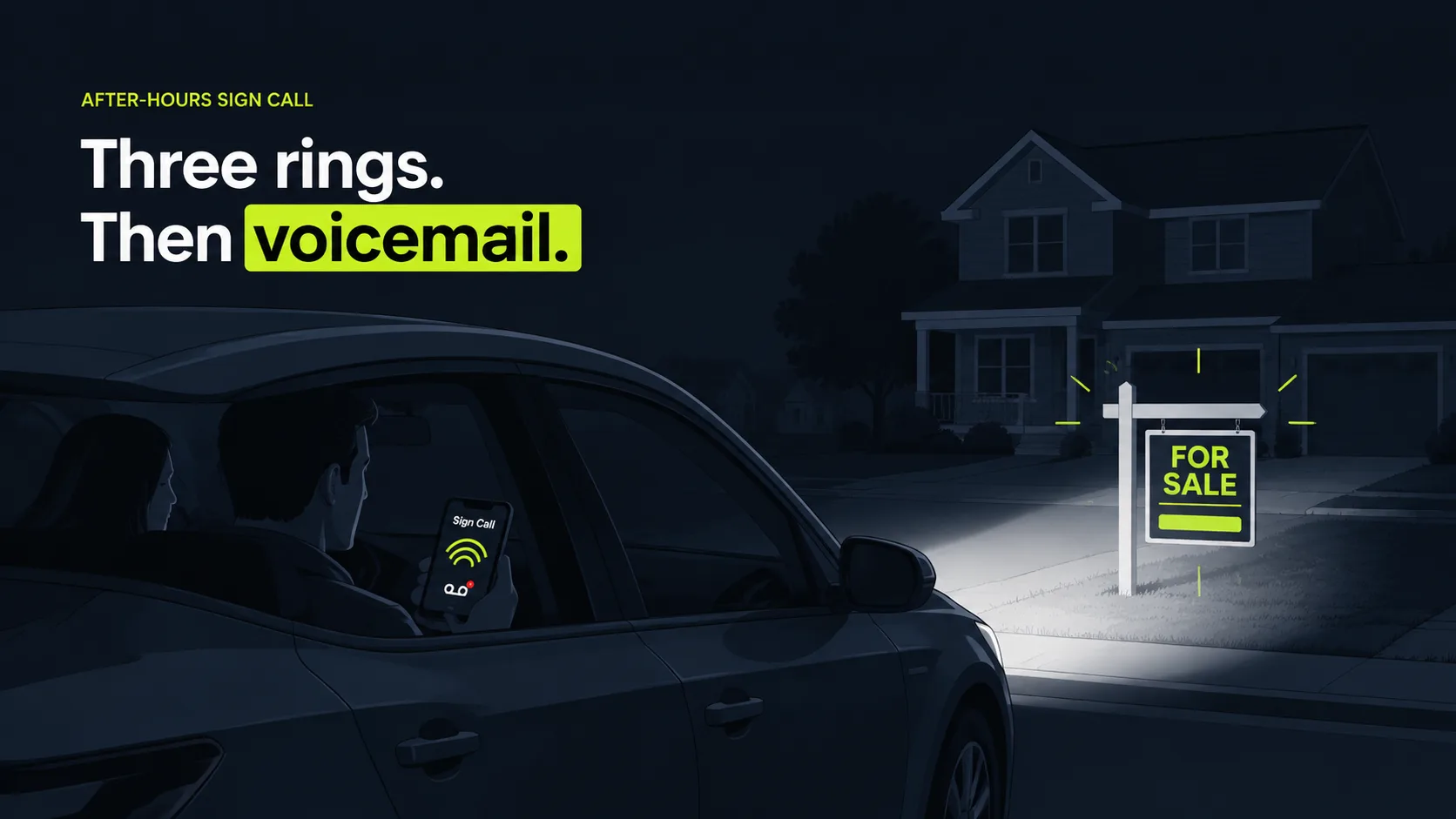
Remember the couple at the curb. The lights are off, the sign is glowing, and your number is on their screen. Behind them is a homeowner down the street wondering what their place is worth, and a renter scrolling the same portal. A real estate answering service that works sorts all three on the first ring: the buyer gets a showing, the seller gets a listing appointment, the renter goes to leasing, and the hot ones reach a human fast.
Want to see where your team's calls are slipping? Book a Free Call Audit, a 20-minute, no-pressure call where we map which call types you are losing and what capturing them would be worth. Setup is backed by a guarantee: 5 booked jobs in 30 days or your setup fee back. Prefer to run the math yourself first? Try the Missed Call Revenue Calculator.
Written and reviewed by Maxim Skorohod, Founder of SkoreHood, who builds AI answering and voice automation for small service businesses. Last reviewed: 2026-10-14.
Questions or corrections? Contact our team or read about SkoreHood and our editorial standards.
Still sending callers to voicemail?
An AI voice agent picks up the calls your team misses in under a second, qualifies the job and books it into your calendar.